


High-Temperature Heat Flux Sensors for Fire Testing & Extreme Thermal Environments
FluxTeq HTHFS-01 high-temperature heat flux sensors are designed for harsh thermal environments where standard thin-film heat flux sensors may not survive, including fire exposure, radiant heat testing, combustion research, protective material evaluation, and high-temperature R&D.
Recommended Sensors:

HTHF-Probe
Probe-style fire, combustion, or extreme-environment measurements

HTHFS-01
Surface-mounted high-temperature heat flux in fire, radiant panel, flame, and hot-wall environments
Sensor-selection note: The best sensor depends on peak temperature, heat flux range, flame exposure, mounting method, cooling/sinking conditions, and whether the measurement is incident, absorbed, or through-surface heat flux.
Why heat flux matters in fire testing
Temperature alone does not fully describe a fire exposure. Two surfaces may reach similar temperatures while receiving very different heat fluxes depending on radiation, convection, flame impingement, geometry, ventilation, and surface properties.
High-temperature heat flux sensors help researchers and test engineers measure:
-
incident or surface heat flux during fire exposure
-
radiant panel heat flux distribution
-
fire plume and ceiling-jet heat transfer
-
thermal boundary conditions for fire modeling
-
heat exposure to walls, ceilings, tunnel liners, and protective materials
-
validation data for CFD or fire dynamics models
-
combined thermal exposure from radiation and convection
The studies summarized here were conducted by independent researchers. FluxTeq did not necessarily design, perform, or validate the experiments. These publications are provided as examples of how FluxTeq sensors and DAQ systems have been used in battery thermal research.
Link: https://nrc-publications.canada.ca/eng/view/object/?id=38e02b27-e352-4189-bcfc-3e38fe1be12d
Application: Large-scale structural fire testing, mass timber fire exposure, radiant heat to walls and ceilings
Relevant sensor: HTHFS-01
This National Research Council Canada report documents five large-scale fire tests performed on a two-story mass timber structure. The tests studied fire dynamics, fire safety during construction, open-plan office fire behavior, residential fire scenarios, and the influence of exposed mass timber structural members on fire severity and duration. The report states that two FluxTeq HTHFS-01 heat flux sensors were installed in Bay 1 to measure radiant heat received by the wall and ceiling. One HTHFS-01 was mounted on the back wall facing Cubicle 3 at 1.5 m high, and the other was mounted on the ceiling above Cubicle 1.
Large-Scale Fire Tests of a Mass Timber Building Structure for MTDFTP
National Research Council Canada, 2023

Link: https://www.sciencedirect.com/science/article/abs/pii/S0017931015000022
Application: Separating radiative and convective heat-transfer components
Relevant FluxTeq product: HTHFS-01
Use-case fit: Fire research, compartment fire studies, flame exposure, thermal boundary condition analysis
In fire environments, total heat flux is often a combination of radiation and convection. This study is useful for customers trying to distinguish how much of the thermal exposure comes from flame radiation versus hot-gas convection. FluxTeq lists this paper among HTHFS-01-related publications.
Partitioning Measurements of Convective and Radiative Heat Flux
International Journal of Heat Transfer, 2015
Link: https://rosap.ntl.bts.gov/view/dot/83645
Application: Tunnel liner fire resistance, concrete spalling, ASTM E1529-style hydrocarbon fire exposure
Relevant sensor: HTHFS-01
This U.S. DOT-sponsored project studied the fire resistance of steel fiber-reinforced concrete tunnel lining panels with and without polypropylene fibers. Eight concrete panels were exposed to severe one-sided heating using a gas-fired radiant panel while under axial compressive load. The test apparatus was benchmarked against the ASTM E1529 hydrocarbon fire exposure, which corresponds to a target heat flux of approximately 158 ± 8 kW/m².
The researchers used a compact FluxTeq HTHFS-01 heat flux sensor to map the spatial heat flux distribution across the heated surface. The HTHFS-01 was placed in direct contact with the front surface of a steel plate, and heat flux was measured at 12 separate locations during separate one-hour heating tests. The measured values were then normalized to create a heat-flux percentage contour across the test surface.


Fire Resistance of Tunnel Liners with Steel and Polypropylene Fibers
U.S. Department of Transportation Report, 2023
Linking leaf traits and litter flammability using a novel framework, tested with Brazilian Cerrado trees
Functional Ecology, 2025
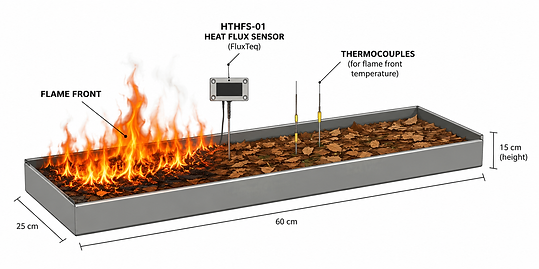
Link: https://besjournals.onlinelibrary.wiley.com/doi/10.1111/1365-2435.70032
Application: Litter flammability, vegetation fire behavior, wildfire ecology
Relevant sensor category: HTHFS
Researchers used a FluxTeq HTHFS-01 heat flux sensor during controlled burn experiments of constructed leaf-litter fuel beds. The study evaluated how leaf traits such as size, curl, specific leaf area, and foliar aluminum content influenced surface fire behavior in Brazilian Cerrado tree species. The HTHFS-01 was positioned 37.5 cm from the ignition location at a height of 30 cm to measure heat flux during the burns, while thermocouples, an infrared temperature sensor, and a CR1000 datalogger recorded additional fire behavior data.
A Hybrid Method for Measuring Heat Flux
Journal of Heat Transfer, 2010
Link: https://www.researchgate.net/publication/245363439_A_Hybrid_Method_for_Measuring_Heat_Flux
Application: High-temperature heat flux measurement method, sensor response improvement, backing-material independence
Relevant sensor category: HTHFS / Hybrid Heat Flux Gauge
This ASME Journal of Heat Transfer paper presents a hybrid heat flux measurement method that combines spatial temperature measurements, like a differential heat flux sensor, with temporal temperature measurements, like a slug calorimeter. The goal was to improve heat flux sensor time response, accuracy, and versatility, especially when mounted on materials with very different thermal conductivities. The authors report that changing the backing material thermal conductivity by four orders of magnitude caused only an 11% change in sensor response, and that the hybrid method improved temporal response by up to a factor of 28 compared with a standard spatial sensor.
The paper experimentally validated the method using an HTHFS sensor. The sensor included a thermopile to measure temperature difference across the sensor, plus two thermocouples to measure face and back surface temperatures. The paper reports a differential-mode sensitivity of 579 ± 29 µV/W/cm² and tested the HTHFS under both water-cooled and insulated backing conditions.
Temperature Predictions Using Hybrid Heat Flux Gage MeasurementsFire Technology, 2015
Link: https://link.springer.com/article/10.1007/s10694-013-0381-2
Application: Predicting material/surface temperature response from heat flux measurements
Relevant sensor category: HTHFS / Hybrid Heat Flux Gauge
Use-case fit: Fire testing, thermal model validation, material response prediction
This paper examines how hybrid heat flux gage measurements can be used to predict temperature response during fire exposure. That is a strong application story because it connects heat flux measurement directly to engineering outcomes: predicting how hot a material or surface may become under a given fire exposure. Springer lists the paper in Fire Technology, Vol. 51, pages 723–746.
Link: https://www.sciencedirect.com/science/article/abs/pii/S0379711213001240
Application: Fire thermal boundary condition measurement
Relevant sensor category: HTHFS / Hybrid Heat Flux Gauge
Use-case fit: Fire testing, fire model validation, thermal exposure characterization
This study focused on measuring fire thermal boundary conditions using a hybrid heat flux gage approach. This is highly relevant to customers who need to understand the actual thermal exposure produced by a fire, flame, or radiant test apparatus rather than relying only on temperature measurements. The paper is listed in FluxTeq’s HTHFS-01 publication list and is indexed as a Fire Safety Journal article.